
















If you have urinary symptoms from an enlarged prostate, you may feel stuck between pills that do not help enough and surgery that feels Prostate Artery Embolization (PAE) for Enlarged Prostate: What You Should Know
If you’re researching Prostate Artery Embolization (PAE), you’re likely looking for answers about treating symptoms of an enlarged prostate, also called Benign Prostatic Hyperplasia (BPH). Many men want relief from urinary symptoms but may not be ready for surgery. That’s why Prostate Artery Embolization for BPH has become a growing treatment option.
PAE is a minimally invasive procedure designed to reduce prostate size and improve urinary symptoms without traditional surgery.
What Is Prostate Artery Embolization?
Prostate Artery Embolization (PAE) is a non-surgical treatment for an enlarged prostate. During the procedure, a physician uses advanced imaging to locate the arteries supplying blood to the prostate. Tiny particles are placed into those arteries to reduce blood flow.
Over time, this reduced blood supply causes the prostate to shrink, which may help improve urinary flow and reduce pressure on the bladder.
Unlike procedures like TURP, PAE does not remove prostate tissue. Instead, it works from inside the blood vessels.
What Symptoms Does PAE Treat?
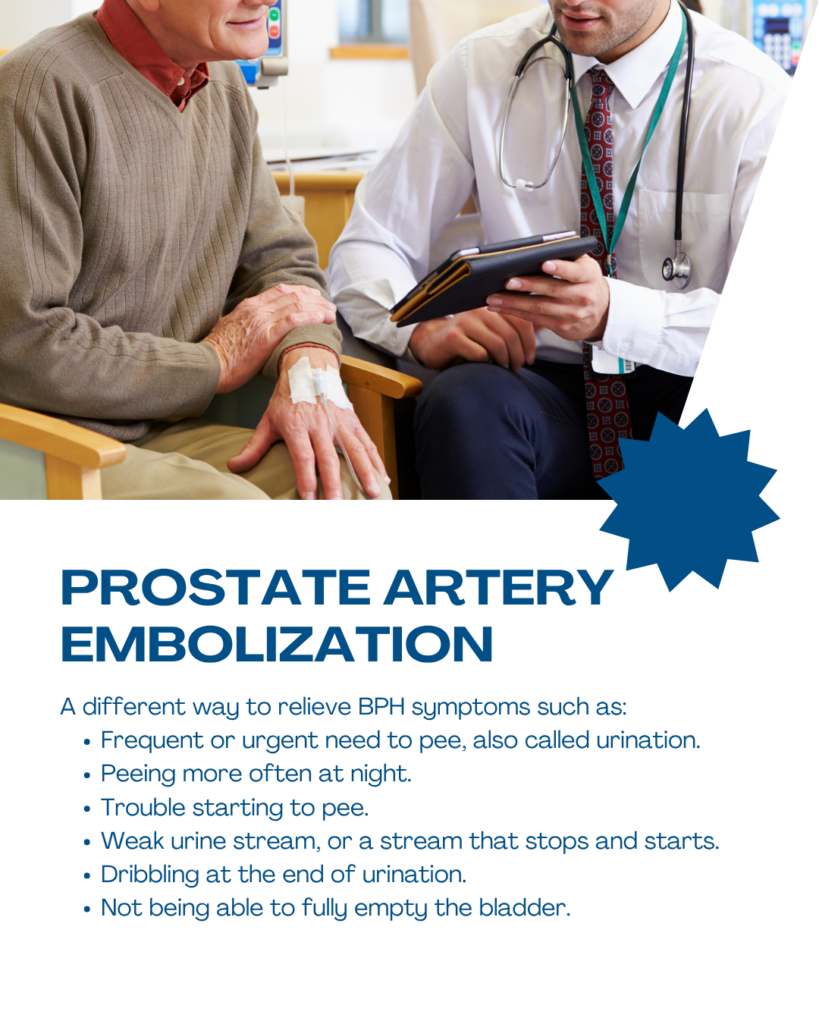
Men often explore Prostate Artery Embolization for BPH symptoms when daily life becomes disrupted by:
- Frequent urination
- Weak urine stream
- Trouble starting urination
- Urgency
- Waking up multiple times at night to urinate
- Feeling like the bladder doesn’t fully empty
These symptoms are commonly associated with Benign Prostatic Hyperplasia (BPH), a non-cancerous enlargement of the prostate that becomes more common with age.
How Does Prostate Artery Embolization Work?
PAE is performed by an interventional radiologist through a small entry point in the wrist or groin. A thin catheter is guided into the prostate arteries using real-time imaging.
Once the catheter is in place, embolic particles are released to reduce blood flow. The goal is to shrink the prostate naturally over several weeks.
The procedure usually takes about 1–2 hours, and most patients go home the same day.
Who Is a Candidate for Prostate Artery Embolization?
A good candidate for Prostate Artery Embolization may include men who:
- Have moderate to severe BPH symptoms
- Have an enlarged prostate confirmed by imaging
- Want to avoid surgery
- Have not found enough relief with medication
- Want to preserve sexual function when possible
Not everyone with urinary symptoms is automatically a candidate. A proper evaluation is important to determine the cause of symptoms.
What Are the Benefits of Prostate Artery Embolization?
Many patients ask, “What are the benefits of PAE?”
Potential benefits may include:
- Minimally invasive treatment
- No cutting through the urinary tract
- Outpatient procedure
- Faster recovery compared to surgery
- Lower risk of retrograde ejaculation compared to some BPH surgeries
- Symptom relief without long-term medication use
For many men, PAE offers a middle-ground option between medication and surgery.
What Is Recovery Like After PAE?
Recovery after Prostate Artery Embolization is often quicker than traditional prostate surgery. Many patients return to light activity within a few days.
Some temporary side effects may include:
- Mild pelvic discomfort
- Burning with urination
- Increased urgency
- Temporary urinary irritation
Results are not immediate. Many men begin noticing symptom improvement within 1–2 weeks, with continued improvement over several months.
PAE vs TURP: What’s the Difference?
One of the most common questions is PAE vs TURP.
- TURP removes prostate tissue and may provide faster symptom relief.
- PAE shrinks the prostate without surgery and often has less downtime.
- Both have advantages depending on prostate size, anatomy, and patient goals.
The best treatment depends on your individual symptoms and priorities.
Is Prostate Artery Embolization Right for You?
If you’re exploring treatment options for enlarged prostate, Prostate Artery Embolization may be worth learning more about. It has become an increasingly recognized option for men seeking relief from BPH symptoms with a less invasive approach.
The most important first step is a thorough evaluation to understand what’s causing your symptoms and what treatment options may fit your goals.
This article is for educational purposes only and does not provide medical advice, diagnosis, or treatment recommendations. Always speak with a qualified healthcare provider about your specific condition.